

A Consumer Claim Survives Only While Its Premises Hold
In the computational argumentation systems considered here, a pleaded consumer claim sits in the model as a conclusion supported by factual and legal premises. It remains acceptable only while those premises survive counterclaim, undercutting attack and the proof standard assigned to the issue.
This design marks a practical departure from earlier production-rule encodings. A production rule could match the recorded facts, fire a legal conclusion and leave that conclusion in force after contrary material arrived. Defeasible models continuously reassess whether the supporting argument still stands. A newly recorded defence may defeat the remedy, challenge a pleaded fact or sever the inference connecting fact to remedy.
That distinction matters across drafting, advice and decision support. Useful software must reveal why the claim remains standing. A rule match alone tells counsel little about the unresolved attacks that may decide the file.
Turning Particulars and Defences into an Argument Graph
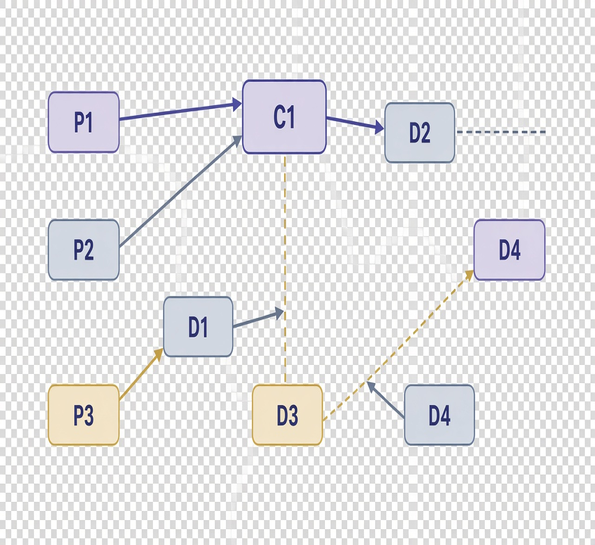
Consider a claim concerning an appliance alleged to have overheated during ordinary use. The particulars might supply a factual premise about the overheating, a legal proposition governing conformity, and a conclusion seeking the available remedy. The trader’s response can attack this structure in several distinct places.
- Rebuttal: the defence advances a conclusion incompatible with entitlement to the remedy.
- Premise attack: the trader denies that the appliance overheated in the circumstances pleaded.
- Undercut: the trader accepts an event occurred while disputing that it warrants the proposed legal inference.
Unstructured document storage collapses these differences into passages of text. Search may retrieve the passages, but later automated reasoning cannot reliably determine whether the defence denied an event or challenged its legal significance. Structured issue nodes and typed attack links preserve that granularity.
What Each Edge Must Record
An attack edge should identify its source argument, target node and attack type. The graph also needs provenance back to the relevant pleading, instruction or legal proposition. Without that connection, an apparently precise diagram becomes another opaque summary.
Proof Burdens Move from Issue to Issue
Burden of proof works best as a procedural parameter attached to an issue. The parameter records who must produce a successful argument and which proof standard the argument must satisfy at that stage.
- The claimant supplies premises supporting the pleaded defect.
- The model tests that argument against the initial threshold assigned to the defect issue.
- Once the threshold is met, the trader may need to establish an applicable statutory defence or due-diligence argument.
- Any new counterargument is assessed under the standard attached to that specific issue.
Computational models can represent standards analogous to a scintilla, preponderance, or clear and convincing threshold. The same body of arguments may therefore be acceptable under one encoded standard and insufficient under another. The The Carneades model of argument and burden of proof provides a foundational account of this relationship between argument acceptability and proof burdens.
The encoding reconstructs burden allocation. It cannot find facts independently or assess the credibility of live witness testimony.
Exceptions Need Defeasible Rules and Explicit Priorities
Strict and defeasible rules serve different jobs. A strict rule preserves an inference whenever its premises hold. A defeasible consumer-protection rule supplies a conclusion that may yield when the graph contains a recognised exception.
Return to the overheating appliance. Evidence contradicting the alleged defect rebuts the claim conclusion. Material denying ordinary use undermines a factual premise. A provision that blocks the route from defect to the remedy undercuts the inference. Keeping these attacks separate prevents a denied fact and a disputed legal warrant from disappearing into one confidence score.
How the Model Resolves Conflict
Priority orderings settle conflicts within the graph. A more specific enactment may outrank a general rule; a later instrument may control an earlier one where the legal framework supplies that ordering; expressly ranked reasons can be encoded directly. These preferences operate as conflict-resolution devices. They do not establish that an enactment applies to the file without supporting premises.
Drafting from Undefeated Claims and Counterclaims
An argument-aware drafting tool can consume a bounded set of material: issue nodes, supporting premises, known attacks and the proof standard attached to each issue. This supports a disciplined dual-generation pattern.
- Undefeated claim arguments populate a particulars skeleton.
- Undefeated counterarguments populate a defence skeleton.
- Disputed or unverified facts remain marked as open prose fields.
Clause-library drafting and argument-graph drafting solve different problems. A clause library wins when established language must be reused consistently. An argument graph wins when the opposing party adds a new point, because the tool can trace which issue, premise or inference the point attacks. A combined workflow can select wording from the library after the graph determines the required argumentative function.
Pleading Boundary
Graph generation should stop at the structural skeleton. It does not certify the final pleading or fill factual gaps through inference.
Attack Traces Make Advisory Outputs Inspectable
Two advisory interfaces can process the same consumer file. The first returns a likely-outcome token. The second displays accepted arguments, defeated arguments and residual attacks. Only the second output gives the lawyer a route back to the brief, the governing provisions and the client’s instructions.
Inspection should proceed node by node: confirm the source of each premise, examine the rule connecting it to the conclusion, review attacks, and check the applicable proof standard. An unresolved attack should remain visible even when a predictive annotation favours the claim.
Within this legal-AI research tradition, computational argument operates as a reasoning layer for professional and research use. Its trace does not bind a court or regulator, and it does not replace advice on a live matter. The CEPEJ European Ethical Charter on AI in judicial systems supplies relevant ethical context for keeping judicial AI outputs transparent and controllable.
Keep Predictive Analytics Downstream of Legal Reasons
A practical decision-support screen should foreground four elements: issues in dispute, arguments currently undefeated, arguments currently defeated and proof standards still unmet. That arrangement tells counsel where the case structure is stable and where further evidence or legal analysis may be required.
Predictive analytics can then annotate the graph. A prediction attached to an issue node has a reviewable object; counsel can compare it with the pleaded facts and attack structure. A free-standing score conceals whether the model reacted to a missing premise, a strong rebuttal or a pattern learned from unrelated files.
The division of responsibility remains clear. The model flags an unanswered attack. Counsel decides whether to plead, seek evidence or pursue settlement.
Sources
- The Carneades model of argument and burden of proof
- CEPEJ European Ethical Charter on AI in judicial systems
Ship the Argument Structure Before the Score
A consumer-claim tool should expose claim and counterclaim nodes, typed attack relations and issue-specific proof standards before adding predictive output. Validate that graph against the underlying materials first.
If a predictive layer follows, require every material prediction to point back to the relevant nodes and attacks. That design lets a lawyer accept, reject or repair the reasoning. Ship the inspectable argument graph as the primary product, and keep every score subordinate to it.