

When Consumer Disputes Moved onto a Written File
Statutory drafters structuring informal dispute resolution schemes deliberately stripped out live cross-examination and formal pleadings. They decided instead that adjudicators would weigh consumer claims on a closed paper dossier assembled from the consumer's initial form and the respondent firm's business file. Regulatory complaint-handling frameworks typically give respondent firms a statutory window of up to 8 weeks to issue a final written response before a dispute becomes eligible for ombudsman referral. Once a scheme formally requests the business file, firms generally face a production deadline of 14 to 21 calendar days to submit all relied-upon records.
That file-based method dictates what automated reasoning systems and human investigators must extract from a submission. A dated sequence of events, the firm's conduct across the customer relationship, and records made at the time of the transaction form the core materials a determination turns on. The emotional register of a complaint stays in the dossier as background context; lexical intensity does not supply the legal or factual test the scheme applies.

The Complaint, the Firm Response, and the Attachments
Case intake protocols treat the initial submission packet as a bounded evidentiary record. Investigators and intake parsers assess what an omitted ledger or unproduced attachment implies about the firm's record-keeping, evaluating the dossier as submitted without pausing every file for open-ended discovery.
A standard case file bundles five primary artifacts:
- The consumer's narrative form setting out the grievance and desired outcome
- The firm's final response letter detailing its internal findings
- Dated correspondence logs capturing email, postal, and webchat exchanges
- Raw customer relationship management (CRM) notes or billing ledger screenshots
- Prior settlement correspondence documenting any financial tender made before referral
The structural absence of an expected record shapes the evaluation directly. For the working example traced across this methodology, the dossier tracks a service cancelled within an initial cooling-off window where the principal refund remained unpaid across a multi-week interval. Every downstream triage check interacts with what these five artifacts prove—or fail to prove—about that cancellation and the subsequent refund delay.
Building One Timeline from Two Written Accounts
Automated intake pipelines for legal text can segment narratives by paragraph sentiment or use temporal extraction passes that anchor every asserted action to an explicit or inferred calendar date before any downstream scoring occurs. Merging the consumer's submission and the firm's response into one chronological spine turns competing stories into testable conflicts of date and act. Strong phrasing in either narrative cannot supply a missing calendar entry.
Chronology extraction maps dispute events onto six canonical lifecycle nodes:
- Initial contact: The baseline interaction establishing the service or query.
- Notice of cancellation: The specific date the consumer exercised the right to terminate.
- Firm acknowledgement: The first verified receipt of the termination notice.
- Internal investigation: Logged review of the account ledger or service history.
- Substantive explanation: Communication of the policy or contractual basis for the firm's stance.
- Payment execution or refusal: The final transfer of funds or formal rejection of the claim.
Once events from both written accounts sit on a single axis, the parser measures the intervals between nodes. Unexplained intervals of 14 to 28 calendar days without outbound firm contact or logged internal escalation are flagged by the parser as operational silence.
Reading Firm Conduct Against Fair-Treatment Duties
Adjudication quality rubrics decouple the tone of the final decision letter from the underlying administrative trail. Reviewers verify whether fair-treatment duties were performed during the live customer relationship, starting from the earliest operational query, beyond the window after a formal escalation was logged.
The conduct audit evaluates four binary milestones across the merged timeline:
- Prompt acknowledgement of the consumer's initial request
- Factual investigation of the underlying account history and system logs
- Coherent explanation of the contractual or policy basis governing the decision
- Active remedial steps taken to put the matter right when an error or delay is identified
Comparing process facts against outcome language exposes administrative failures that polite prose often masks. Unanswered correspondence, shifting explanations across different customer service agents, and protracted silence are measured against the four milestones. A courteous closing letter sent at week 8 does not cure a file showing zero investigative entries during the preceding 40 business days.
Records Made at the Time Against Accounts Written Later
Evidentiary weighting rules in informal schemes borrow from administrative fact-finding by assigning primary probative weight to system-generated artifacts captured in the ordinary course of business. Retrospective narratives written weeks later in the firm's final response carry the weight of argument, while contemporaneous records provide the factual foundation.
Contemporaneous Record Verification Thresholds
In automated document-linking passes, any factual assertion in the firm's final response that cannot be mapped to a timestamped attachment within a 48-hour window of the alleged event is tagged as an unsupported claim.
Contemporaneous anchors require immutable system timestamps, such as automated interactive voice response (IVR) call metadata, billing ledger adjustments, or dispatch receipts created within 24 hours of the disputed interaction. A polished final response letter can read as complete while resting on no document from the relevant day. During intake, the document-linking pass connects each factual assertion in the correspondence to a timestamped attachment; in disputes turning on unrecorded in-person conversations at a physical branch or doorstep where neither party could generate a system timestamp, strict contemporaneous-document linkage yields to consistency assessments across subsequent party actions.
What an Early Remedy Offer Leaves Still Open
Case-scoping logic in justice automation prevents intake models from treating the presence of a settlement figure as a binary resolution signal. An early offer can demonstrate an attempt to treat the consumer fairly while simultaneously narrowing what the scheme still has to decide. To isolate what remains live for determination, the parser decomposes any pre-referral tender into distinct heads of loss.
Offer decomposition inspects four structured attributes:
- The calendar date of tender relative to the initial complaint and cancellation notice
- The itemized pecuniary heads covered by the proposed payment
- Explicit consumer acceptance or rejection of the tender in subsequent correspondence
- Unaddressed consequential losses or administrative charges remaining on the ledger
Splitting closed issues from residual claims prevents premature closure in automated prediction challenges. In a cancelled-service dispute, a goodwill credit or partial principal return resolves the paid balance yet leaves ancillary cancellation fees and multi-week loss-of-use intervals open as residual heads of dispute.
Ordering Triage Features So Tone Cannot Outrank the File
When designing queue-prioritization models for consumer claims, justice technologists choose between sentiment-led ranking and file-structure cascades. A sentiment-led architecture elevates files containing high-arousal adjectives and urgent rhetoric. That approach pushes vocal complainants to the top of the queue while leaving quiet, structurally defective firm files buried. By contrast, a file-structure architecture enforces a strict hierarchical feature cascade where documentary defects are evaluated and locked before any lexical tone features are read.
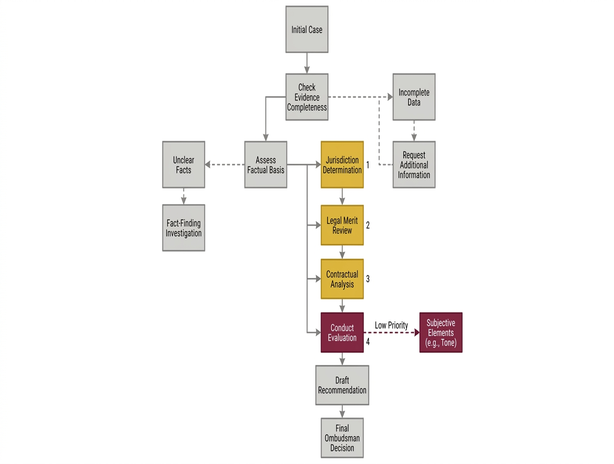
The structural approach governs when fairness and evidentiary accuracy define the queue priority. The feature evaluation hierarchy enforces a four-tier sequence:
- Timeline completeness and silence gaps: Identifying missing dates and unexplained 14-to-28-day freezes.
- Contemporaneous document linkage: Verifying whether retrospective claims map to 24-to-48-hour system artifacts.
- Fair-treatment milestone coverage: Auditing acknowledgement, investigation, explanation, and remediation across the live relationship.
- Residual offer scope: Isolating uncompensated fees or delay periods left untouched by early tenders.
Emotional phrasing in the consumer's narrative stays recorded as background context for the investigator reading the file, without acting as the signal that promotes a case. Furthermore, a mandatory human-in-the-loop gate requires a caseworker to verify the extracted documentary flags before any automated outcome projection is recorded on the triage dashboard. The model sorts the dossier; human oversight governs the determination.
Walking the Cancelled-Service Refund from First Contact to What Remains
Applying this four-tier file-structure sequence to the working cancelled-service dossier shows how an intake pass strips away rhetorical framing to surface the exact points requiring adjudication. You begin by merging the consumer's form and the firm's week-8 final response onto a single timeline spanning 45 calendar days:
- Day 1: The consumer submits a valid notice of service cancellation within the cooling-off window, anchored by an automated webform receipt timestamped within 24 hours.
- Day 12: The firm's final response asserts that an agent placed an outbound call to discuss account retention, but the attachments contain no corresponding IVR call-log metadata within a 48-hour window of that date.
- Days 1 to 30: The raw CRM screenshots show zero internal investigative entries or ledger checks across the 29-day interval following the cancellation notice.
- Day 30: The firm tenders a partial refund returning the principal service charge, while deducting and retaining an administrative cancellation fee.
- Day 45: After the consumer rejects the partial figure as a full settlement, the firm issues a courteous week-8 final response letter repeating the unverified Day 12 outreach claim.
When you run this merged record through the hierarchical triage cascade, the system isolates what the partial refund closed and what remains live for the adjudicator. The principal service sum is marked resolved as of Day 30. The reviewer still has to decide two live issues: whether the firm had any contractual basis to withhold the administrative cancellation fee on a cooling-off termination, and whether the 30-day delay before tendering the principal sum warrants a remedial award for flawed conduct.
The automated pass presents the caseworker with four ordered review flags for human confirmation:
- Timeline silence and missing date anchor: The evidentiary gap surrounding Day 12 and the absence of verified firm action across the initial 29 days.
- Unsupported retrospective account: The firm's assertion of a Day 12 retention call, tagged as unverified due to the missing contemporaneous call log.
- Incomplete fair-treatment step: The omitted investigation milestone between Day 1 and Day 30, which the polite tone of the Day 45 letter cannot cure.
- Residual head of dispute: The unreturned administrative cancellation fee and the multi-week delay interval left open by the Day 30 partial refund, with the consumer's frustrated phrasing logged solely as background context.